



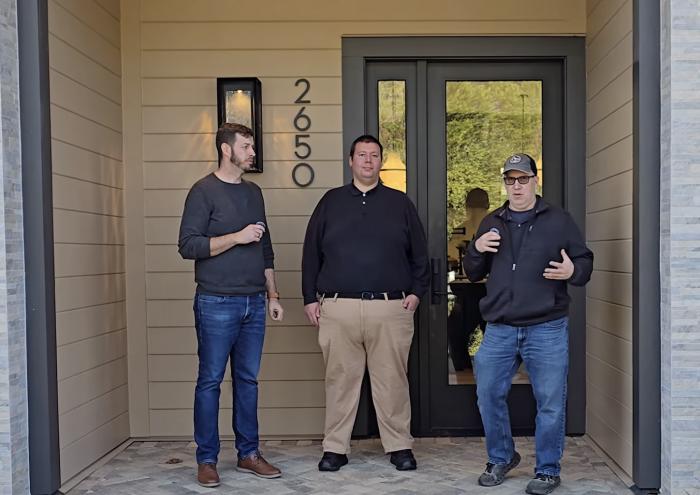
Dar Kashi and his team at Kashi Custom Homes have built a luxury home that is also a Platinum EarthCraft Home in East Cobb, Georgia that proves you can have it all. This home certainly has a lot to boast about. First of all, it’s beautiful and includes many high-end details including double kitchen islands, 2 washer and drier sets, a second floor wet bar suite, and a rooftop deck. It’s also built for energy efficiency with variable speed heat pumps and solar panels. Several features support strong indoor air quality including, ERVs and dedicated dehumidification equipment, and the decision to go all electric for HVAC, water heating, induction cooking, and even a vapor fireplace. Every consideration was given to comfort with high performing systems, and even several considerations for noise reduction including window selection, insulation, and staggered monopoly framing.
Dar Kashi was kind enough to agree to an extensive Q&A with Green Builder Matt Hoots of Sawhorse, Inc. and Rate It Green to explain more about this home and to share information and inspire other homebuyers, potential home buyers and builders. Topics include:
- EarthCraft Certification, Project Goals & Performance Metrics
- Noise reduction
- Going all electric
- HVAC & Indoor Air Quality (IAQ)
- High-Performance Windows
- Framing Details
- Air Tightness
- Flooring for Comfort and Durability

Read on, as there are many thoughtful details included in each topic. Share your questions for the building team if there’s something you want to learn more about, or if you have additional questions. For a video introduction to the project, check out this interview and home tour with Dar Kashi, Matt Hoots, and Christopher Matos-Rogers.
EarthCraft Certification, Project Goals & Performance Metrics
What was the original performance goal for this home, and how did EarthCraft Platinum influence your design and construction decisions?
The goal was to build a high performance house since they are a rarity in the area, I decided to do EarthCraft with all 6 badges (EarthCraft Platinum) after attending a class at the SouthFace Institute via the Greater Atlanta Home Builders Association and learning that there hasn't been a house built with all 6 badges since they were introduced - I had to leave my mark! EarthCraft itself didn't really force my hand beyond the typical high performance detailing we decided to employ from the outset. The primary construction decisions that impacted design were monopoly framing and the desire for a simple roof line - those architectural choices made the detailing much simpler.
For buyers comparing “green-labeled” homes, what verifiable metrics (blower door, HERS, certifications) should they ask builders to provide—and why does that matter?
I'd say the most important metric, and easiest to verify is going to be a blower door score. Lowering your ACH50 is not so easy when the home is finished and ready to live in. Certifications are neat as they have a process with someone verifying along the way, but they aren't right for all projects, especially if the project devolves into "point chasing" or targeting an audience that isn't correct for the home. HERS score is a great tool for comparison between similar homes, but keep in mind the homes need to be similar which can be a challenge.
I think following best practices, having a mechanical design that is verified/commissioned, and verifying a blower door score already places the house in the top 10% of homes alone, the rest is icing on the cake!
Many buyers see a HERS score but don’t understand it—what does a score of 22 really mean compared to a typical new home?
A HERS score is a comparison of energy usage to the reference house - the reference house uses 100% energy to use/maintain the home. So compared to the reference house, 2650 Roswell Rd uses 22% as much energy. So it takes nearly 5 years to use as much energy as the reference house in a year if the houses were similar in size. The houses need to be similar in size for the HERS score to be comparable - larger homes inherently use more energy.
Why is HERS a more reliable metric than “energy-efficient” marketing claims or material checklists?
HERS references energy usage, which is more concrete than just a generic statement of "energy efficient" - and you will notice it in your utility bills month-to-month. Materials don't really play into HERS outside of their individual performance metrics improving the score.
What are some of your favorite design features on the house that are not green building-related?
EarthCraft has a focus on aging in place, and we took that to heart when we designed the house, having the master on main, office/6th bedroom on main, keeping all of the doors 3' wide, and providing an elevator pit for a future elevator if desired. We also placed an emphasis on entertaining with the wet bar suite upstairs, rooftop deck, and stairs down to the rear patio that connects back to the LDK - great flow for guests so they're never too far from the action. Also, the motorized stairs to the attic; everyone dreads going into their attic on their rickety ladder rated for 200 pounds, so their filters never get changed, but with a motorized stair access rated for 500 pounds and the attic being conditioned, the barrier to attic access is all but eliminated. And of course, the centerpiece is the sexy mono stringer staircase wrapping the elevator pit hidden by the rock garden.
Noise Reduction
This house is exceptionally quiet despite being on a busy road—what specific wall, window, and framing strategies made the biggest difference?
From inside to outside, we have 5/8" QuietRock, 2x4 staggered studs 24" OC on 2x6 plates so the insulation can weave through, then the ZIP system, Cor-A-Vent SV-3 Rainscreen, then James Hardie siding. I think the rainscreen plays a benefit in minimizing road noise from traveling through the fiber cement cladding as easily, then what does make it through, the staggered studs and QuietRock take care of. For windows, we went with Pella triple pane casement windows; casement windows, regardless of style, have less air leakage, and where there is air leakage, noise can seep in. The triple pane of glass also has an improved STC rating, further reducing noise transmission. If I had to attribute the biggest difference for noise, it is the staggered studs followed closely behind by the monopoly framing easily minimizing air leakage and thus noise seepage.

Why did you select triple-pane windows and Rockwool insulation, and how do they support both acoustic and thermal performance?
The price difference between the double and triple pane windows was ~10% and the triple pane windows boasted lower U-Factor, SHGC, and higher STC (important due to the location for mitigating noise). The Rockwool in this build is strictly for acoustic performance between the floors and between the rooms, paired with the staggered studs and 5/8" drywall, it does a fantastic job at mitigating noise.
Going All-Electric in a luxury home
You chose an all-electric approach in a luxury home—why was that important, and how does induction cooking enhance both performance and the homeowner experience?
With tighter homes, we need to take more care for the occupant's health, and the most egregious pollutant in the house is a result of combustion. With the removal of natural gas/combustion, that really impacts three major appliances in modern homes: fireplace, cooking, and water heating.
For the fireplace, we selected an Aquafire vapor waterplace - we no longer need fireplaces to heat the home and they are rarely used, so they're primarily decorative features of the home, and I believe the vapor analogs are the best looking substitutes. Using a vapor waterplace also allows us to omit the chimney, a massive hole in the envelope, tightening our air leakage numbers. If a real fire is desired, they are always better in a communal setting, outdoors, around a firepit - sitting in a row inside doesn't give the same sense of community.
For cooking, induction is the future, it is the latest and greatest technology for cooking, and is much easier to clean, and safer to use. If you have an absolute need for cooking over flame, that is best done on an outdoor grill rather than an indoor gas range, so you really aren't missing anything in your home cooking life.
For water heating, we went with a Rinnai 80 gallon heat pump hot water heater. HPHWE are the most efficient residential hot water heaters, albeit slow, but they can operate as a standard electric hot water heater in times of high demand if needed. These really act no differently from the end user perspective as a natural gas tanked hot water heater, and with either, paired with a recirculating pump, you are really only going to run into an issue in times of extreme demand where a tankless option may be better suited (which electric units are available).
I'm not anti-gas, and if it wasn't for EarthCraft, I would have actually added natural gas to the exterior of the home, where it belongs. A plumbed grill, firepit, and even decoratives like gas lanterns are all acceptable to me!
Energy Efficiency & Consumption
The home achieved a HERS score of 22—what combination of airtightness, mechanical planning, and renewables made that possible?
Our final air tightness was measured at 0.6 ACH50, the mechanical planning was done before we even started construction with ACH50 targets in mind and verified during construction. Our first blower door test was before insulation but after windows and doors were installed, we scored 1.3 ACH50 (with 1 window missing, just boarded up) - with that we were confident our mechanical design was going to work.
EarthCraft had us recycle drywall and lumber to achieve one of the badges.
This home is close to net-zero—what options exist for future owners to add batteries or expand solar for resilience?
The quickest/simplest option is to expand solar by adding 10-12 more panels to the existing array. For resilience, batteries can be added in the garage.

HVAC & Indoor Air Quality (IAQ)
With 4,650 sq ft served by a 4-ton heat pump, how did envelope quality and load calculations allow you to dramatically downsize the HVAC system?
We used a third party mechanical designer to tackle this. I gave him my target of <1 ACH50 and told him the envelope details and a 3.5 ton unit was specified, but during construction with refrigerant changes and equipment availability, he re-specified the equipment to the 4-ton system we have installed today. The primary driver of system reduction I believe was the duct system, not the envelope. For this small system to work, we needed very low air friction, so we opted for rigid ductwork throughout except for the final ~2' connection to the boots for noise dampening.

How do systems like the ERV, dehumidification, and automated bath ventilation contribute to long-term indoor air quality and durability?
Dehumidification is the primary contributor to long-term indoor air quality and durability. The goal is to keep the air dry so materials in the house can dry with ease and prevent the growth of mold - the killer of buildings and IAQ.
The ERV brings in fresh air and exhausts stale air, important for the occupants of the building. We don't have bath fans in this building, but instead we have the ERV continuously exhausting from the bathrooms, which is generally humid air. We have humidistats to boost the ERV when the humidity rises above 60% and have the dehumidifier targeting 50% humidity throughout the home.
High-Performance Windows
Most buyers hear “triple-pane” and assume it’s just one more layer of glass—can you explain what actually changes in terms of heat transfer, comfort, and sound control?
Triple pane adds another gas chamber as well as another layer of glass. The second chamber of gas lets the glass pane in the center of the two chambers resist the heat transfer better compared to a double pane where both panes are just air-glass-gas and the reverse configuration. That slowing of heat transfer makes the interior glass pane be closer to the interior temperature than the exterior temperature. For sound control, additional mass and spacing helps dissipate sound wave vibrations.
How should homeowners think about U-values when comparing windows, and why is a small numerical difference more impactful than it sounds?
U-Value is the inverse of R-Value, so the lower the U-Value, the higher the R-Value which we use to compare insulation. Time for a math lesson! Going from 0.25 to 0.2 is, in absolute terms, a 0.05 difference (or 5%), but comparatively, the 0.2 is 25% more insulative than the 0.25. A U-Value of 0.25 is equivalent to R-4 (1/0.25) and 0.2 is R-5 (1/0.2); R-5 vs R-4 is 25% more insulative (5/4=1.25). This will be true and more extreme the smaller the numbers, going from a 0.2 to a 0.15 is the same absolute difference as before, but a 33% improvement by comparison and a whopping 67% improvement compared to a 0.25.
In a mixed-humid climate like Metro Atlanta, where do high-performance windows make the biggest real-world difference—energy bills, comfort, condensation, or durability?
All of the above come into play, but comfort and energy are the two big differences. You may never recoup the cost difference compared to your electric bill, but they do help, and if you are going for a resilient home with solar and batteries, there is a slight improvement on system sizing. Comfort is not an easily quantifiable metric, but starting with sound control, high performance windows shine - the 2650 Roswell Rd home is on a busy road but it is silent; the other noticeable element of comfort is the temperature of the interior pane of glass - a high performance window will keep it closer to the temperature of the home instead of the exterior, and you will feel the heat leave your body and enter the cold glass on a winter day more readily on a standard window by comparison as you pass by.
Why do window performance numbers matter more than brand names or aesthetics when you’re targeting low HERS scores?
NFRC data is more important than the brand name for sure, but serviceability does matter - so whatever brand you choose, as long as it can be serviced, I wouldn't worry about it. Aesthetics is a black box, you need to draw the line somewhere between looks and performance, so I won't say either is more important than the other in terms of the whole project, but if you're targeting a lower HERS score, of course the metrics will be most important. If you're targeting a low HERS score, I'd look at a casement or tilt-and-turn window for operable windows, then fixed windows, then I'd let the budget dictate window materials, and then pick based on NFRC data assuming the window fits the architectural style.
If you were explaining window efficiency to someone in plain English, what’s the simplest way to describe how heat actually moves through glass?
Cold is a concept, heat is what can be measured. Heat moves from high heat to low heat (cold) and tries to find balance (equilibrium). If the glass is colder than you, it will steal your body heat. If you are colder than the glass, your body will steal heat from the glass.
Framing Details
You used staggered stud (often called “monopoly”) framing—what problem does this solve that conventional framing does not?
The staggered studs are used for thermal and noise breaks. Heat and noise need a direct path to transfer efficiently, so we try to avoid giving them the chance! Monopoly framing has more to do with how the building sheathing and roof line interact. Typical construction will have roof sheathing and wall sheathing not intersect, leaving a gap for air to enter the attic. In a Monopoly framed house, those two planes intersect so they can be sealed, not allowing air into the structure. The goal is to make a monolithic house as a system compared to several different systems put together to create a house.

How does separating interior and exterior framing members reduce thermal bridging and improve both energy and acoustic performance?
The separation of the framing members removes the direct path for heat to enter from the sheathing to the drywall; now as heat tries to enter the building, it meets the sheathing, goes into the first stud, then immediately finds insulation - not drywall. This same concept works for acoustic performance. As the sound waves hit the house, they dissipate through the siding into the rain screen cavity, hitting the sheathing, vibrating the first set of studs which are entombed in insulation; the sound wave is dissipating at each step so the sound needs to be VERY loud to make it through all those steps, into the second row of studs and then the QuietRock (which is two layers of gypsum separated by another media to deaden sound waves).
What are the cost and complexity tradeoffs of monopoly framing, and why was it worth it on this project?
I think Monopoly framing is more intuitive than traditional framing, the only complexities were explaining it to people who were unfamiliar, and figuring out rafter tails so it didn't look like a Monopoly house when it was finished. I think the cost has more to do with the necessary materials than the layout - you aren't going to Monopoly frame with house wrap, so you are already looking at spending more than a typical new construction home using something like ZIP or a fluid applied barrier. It was worth it on this project to make a very energy efficient home, which was the goal from the outset, a lot of the subcontractors and vendors have never seen it before and were very intrigued to try it out. The attic in most homes are just awful, the attic in this house is actually a pleasant part of the house, which was another goal of the project - make it easy for the occupant to maintain the home.
Air Tightness
ACH50 can sound abstract—how would you explain it using a real-world example homeowners can visualize?
ACH50 is just air changes per hour at 50 pascals, or a 20MPH breeze. The ACH50 score measures how many times the air in the volume of the home is being evacuated from the house under those conditions. The higher the score, the worse it is - as the wind blows, or exhaust fans operate, the air you paid money to condition is being removed from your house and new unconditioned, external air is being introduced, bypassing your filtration, and requiring conditioning which costs more money.
What does a low ACH50 number actually mean for comfort, dust, humidity, and noise compared to a typical new home?
A lower ACH50 score means you get to use and keep your conditioned air longer, impacting your costliest utility for the better. The side effects of a lower ACH50 are side effects from not having as many holes in your house; with less holes, there is less opportunity for dust/pollen and bugs to enter your house, there is less open spaces for sound waves to travel directly through, less areas for water/humidity to just seep in - all of these make a home more comfortable. A typical new home usually doesn't even have a plan around an ACH50 score at all - the code minimum is 5 and is usually not even verified.
Why does improved airtightness allow you to significantly downsize HVAC equipment in this house?
Your HVAC system is manufacturing indoor air using outdoor air as a raw ingredient. If you have the opportunity to not lose your indoor air through the envelope, you don't need to process as much outdoor air to maintain the indoor air, and not needing to process as much outdoor air means you don't need as much capacity in the factory - hence a smaller system.
Flooring for Comfort and Durability
What are some of the “invisible” details behind the walls and ceilings that most homeowners never see, but that significantly improve comfort and efficiency?
Staggered interior studs and Rockwool significantly improve comfort with noise transmission between the rooms, same for hat channel and Rockwool in the ceiling. A neat detail here improving both comfort and efficiency is our sleeper floor system with insulation above slab. The house is slab on grade, and typically that leads to cold floors with direct attachment to the slab, but we have elevated our floors 4-1/2" over the slab to make room for insulation, improving both R-Value and not letting the floors become ice cold in the winter.
A neat high performance detail that improves comfort and structure efficiency is the extremely low deflection ratings in the trusses. Our trusses were specified as L/900 being the minimum acceptable and most are L/999+. This makes for extremely stiff floors, you won't feel like you're walking on a trampoline.
Homeowners often notice “bouncy” floors—how do truss design and deflection ratings influence how solid a house feels?
Minimum truss design lets the floor deflect 1" every 30' (L/360) which is terribly bouncy, especially if you fully load the trusses, and they get worse over time to an ultimate deflection of 1" every 20' (L/240). The house is 40' deep, and the floor system is bisected by a W24 steel beam, making most of the trusses around 20' long. If we designed to the minimum, you would have noticeable dips in the floor and tiles would crack over time, door reveals would become cattywampus - I decided I didn't want any of those issues and specified L/900 or better, or a deflection of 1" in 75'. What we ended up with were trusses rated at L/999+ with ultimate deflection values in the L/900+ range, and over a 20' span like we have in the house, we can expect an ultimate deflection of less than 1/4" - hardly noticeable, and any dips that do appear with age should be hardly perceptible underfoot.
The most vivid example of a bouncy floor is hearing rattling from a dish display as you walk. That won't happen in this house.
What does a deflection rating actually measure, and why does it matter for finishes like tile, stone, and cabinetry?
Deflection is measuring how far the truss bends when loaded at its rated capacity, so for L/360, a 30' span is 360", a truss that has length (L) of 360" would have a deflection of 360"/360 = 1". This bend and snap back is what makes the floor feel bouncy. That bend is also giving the floor a chance to move, and that is what causes cracks to tile and stone floors. Over time that bending leads to a dip or sag which then becomes noticeable at fixed objects like cabinets and doors.
If you'd like to learn more about this luxury EarthCraft home, check out this video tour with Dar Kashi, Matt Hoots, and Christopher Matos-Rogers. Share your questions and comments, and join the discussion!
Related Information


Comments: 1