



The World's Best New Building Award for 2018 goes to the Children Village Complex in Brazil

The Royal Institute of British Architects (RIBA) International Award is one of the most rigorously judged architecture awards in the world. Happening every two years, the winning building needs to achieve project excellence, architectural ambition and promotes a significant social impact.
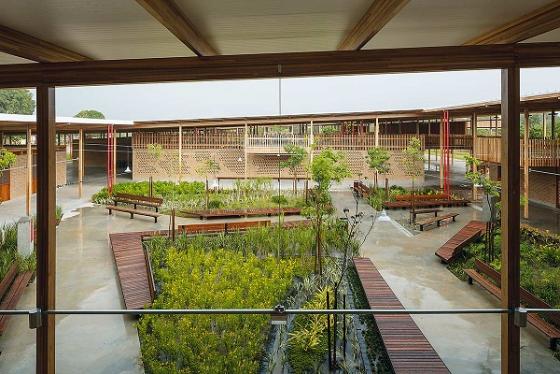
On November 2018, the Children Village complex on the edge of the rainforest in the Tocantins, northern Brazil, was awarded RIBA International Award. In 12 years, it is the first time that a Brazilian project was named the world’s best new building on RIBA. The Brazilian architecture firm Aleph Zero and The designer Rosenbaum developed the complex to provide education for youngsters in rural communities across the country.
The environment designed is a home away from home for children to develop a strong sense of individuality and belonging. The building will house 540 children aged 13 to 18 who go to the Canuanã School, where most of them travel for many hours by boat to study.
The Children Village complex is organized by 2 identical blocks: A female and a male block, the residence is surrounded by 3 large, open, and well-shaded courtyards integrating the study, entertainment and sleep areas.
The tropical ecosystem in this area reaches temperatures of 40C (104F) on summertime, which was one of the biggest challenges to the architects. However, the green building complex offers an exceptional environment designed to improve the lives and well-being of school children by using local resources based on local techniques to develop an efficient building. For example:
-Earth blocks handmade on site were used to construct the walls and latticework, chosen for their thermal, technical and aesthetic properties.
- The outer-facing dormitory walls form an antechamber, brick-walled, forming cobblestones, allowing natural ventilation.
-As a feature of environmental comfort, eaves of four meters bar the entrance of the sun and facilitate the natural ventilation, ideal for the humid climate of the place.
- The high ceiling of the blocks can reach 8 meters high, interrupted by the dormitories, where on them are the collective areas interconnected by walkways. The noise absorption system of the concrete slab consists of rock wool.
-It is a region with abundant rainfall, so the rainwater feeds the water mirrors of the ground floor, which when overflowed, the water goes to the river.
"We tried to make a new feeling and a contemporary interpretation of the traditional ways of building in this area of Brazil," Utrabo, the Aleph Zero architect, said.
To read more:
https://theirworld.org/news/brazil-school-wins-prize-for-best-new-building-in-world
https://sustentarqui.com.br/moradias-infantis-projeto-brasileiro-ganha-o-premio-internacional-riba/
https://sustentarqui.com.br/marcelo-rosenbaum-resgata-recursos-regionais-em-escola-do-tocantins/
Replies: 0