



Home Indoor Air Quality Monitoring & DIY Automation, A Recorded Webinar with Brett Little and Scott Farbman
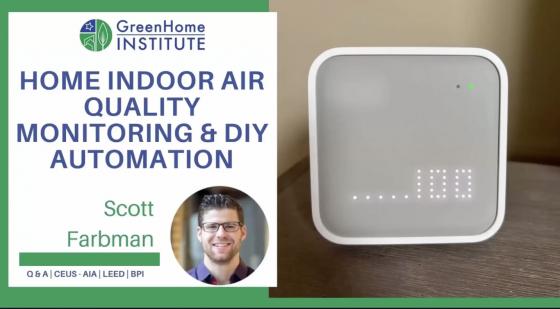

Are you interested in learning more about the mechanics of how we're going to measure and take key steps towards improving our indoor air quality (IAQ?). Brett Little of GreenHome Institute and Scott Farbman, Senior Policy & Ratings Manager at Energy Solutions (also an Architect and Passive House Consultant) invite us into a great and candid conversation about their lived experiences experimenting with indoor air quality monitors in their own homes.
Warning: This video is so good we watched it twice. The thing is, if everyone at the leading edge would share their expertise and experiences like this, we'd all learn so much faster and transform the building industry and heck, our global economy and ecosystems so that building and being healthier and more sustainable were a matter of course. We can give you a preview here, but it's worth watching the video. Continue the conversation and post your questions or comments!
Brett and Scott start with a brief conversation about indoor air quality (IAQ) and how the market has been developing. Since the COVID 19 pandemic, people have spent even more time inside and we've also become aware that clean indoor air matters and is not something we can take for granted. Both Brett and Scott have experimented with multiple air quality monitors and walk us through what their experiences have been, which is also a review of what the industry has been like in the past few years from the consumer perspective.
Put simply, we need clean indoor air as a part of a healthier living environment, especially as we keep tightening up homes and buildings to improve energy efficiency. We do not want to trap toxins and pollutants in our buildings. As part of some incentive and certification programs IAQ monitoring is also required.
In the past, building professionals and commercial hygiene consultants might have been the only ones with IAQ equipment, but the good (and sometimes confusing) news is that there are a growing number of IAQ brands and products on the market. The bad news is that we're still pretty much at an experimental moment where you might need to try a few monitors and a few breads to figure out what works best in your home.
Scott's also an Architect and a Passive House Consultant, but this project has clearly been a personal one for him, and Brett too. Scott has had a "fleet" of 7 monitors, 1 of which is commercial and one of which is for outside air. He compares data from the outside Purple Air monitor to the EPA's reporting
What do the monitors measure? Basics include temperature, humidity, CO2, VOCs, and particulate matter (very fine dust). But there are other pollutants and irritants, including radon. Scott talks us through how he tested how the monitors work with cooking and what some solutions might be to bring in fresh air. (Use your exhaust hood if you have one - every time!) Click to view an introduction to indoor air quality and pollutants and why they're so important. Clean indoor air is a significant air part of making our homes healthier, and increasingly important as we continue to tighten buildings to make them more energy efficient. But sufficient ventilation is essential to bring in enough fresh air to make sure we don’t trap and breathe toxins and pollutants. The #1 advice we've heard before? If you have a kitchen exhaust hood, use it every time you cook, no exceptions. Scott also points out you can do a lot with windows and bathroom exhaust famn, too. More complex mechanical solutions include make up air and ERVs, or energy recovery ventilation.
Scott and Brett share their paths from maybe starting with one pollutant more in mind to trying different monitors to measure different pollutants and to see how they all work including looking at accuracy levels. Scott seemed to be looking at specific pollutants at first, while Brett's journey began with a focus on humidity and the conditions that can lead to mold growth. Both seem to have found that different monitors and sensors measure different pollutants and might also give different measurements and also report in different ways back to the user. So both also seem comfortable managing different equipment and multiple inputs, but clearly they're scientists and love the learning process. Scott became very interested early in his journey in automation, and he has definitely made personal strides to measure and even automate his home air quality and HVAC equipment.
There is such an experimental process and a learning curve it's both comforting and worrying to hear about. We want manufacturing companies to make it easy and to do the thinking for us, but there are just so many factors. At the most basic level, different sensors are needed to measure different pollutants. And as Brett points out, all the monitors do require the consumer to "do something" to get the information - logging into an app, checking a computer screen, and just checking the data generally. So it's hard for one system to do it all. Also, some pollutants are more likely in different places - you don't put a radon sensor or equipment to check for mold conditions in your kitchen ideally, for example. Accuracy also varies, and equipment can degrade over time for various reasons including dust build up. The equipment also seems somewhat vulnerable - there was talk of banging children. And it's not perfect- Brett relays that one monitor that seems ot measure noise pollution might be sensing its own motor noise.
Then there's the question of what we do with this data once we have it. And this is where the presentation moves to automation, and specifically an introduction to Home Assistant, an open-source platform where people can set up their own home management universes, and the possibilities seem limitless. Scott shares a LinkedIn article he posted about Home Assistant. A key strength of this system is that it can combine multiple apps, and many integrations already exist. So a consumer doesn't have to open up multiple apps or look at multiple piece of equipment at all times to learn what's going on in their home. Reactivity is another feature, and really the future of home management. Home Assistant can be programmed to make decisions and turn equipment on and off as conditions change. Even if a device isn't yet smart, one can use tools to enable the through relays that connect to the power source. The user can set parameters and control sequences to adjust for certain conditions and/or time. The systems can even collect data and adjust for peak load pricing if instructed.
Home Assistant is apparently fairly user friendly, with some easy choices and drop down menus. But there's also command prompt scripting for those who are more proficient. Users can design their own dashboard, which really brings the home's data together, as one can then see across sensors and across different conditions over time. Home Assistant and tools like it do require some work and upkeep. Parts of the system may also not always function at 100%, with software changes, company changes, upgrades, and product and sensor aging. Brett seems to have liked using some IAQ equipment that was then discontinued and others where the type or location of the data changed and became less user friendly. There's definitely a point there about an emerging market and some risk of relying on companies that may not be around forever. That said, Home Assistant doesn't appear to be going anywhere. If one can put the effort in, iAQ and related home management data can all be together in a single place. There are versions of Home Assistant that have been packaged for easier use, but Scott was clearly never going to choose those.
What does the future of IAQ monitoring look like? Scott and Brett discuss the possibility of monitoring companies that can track equipment and help consumers figure out what is happening and what might need to be addressed. Equipment is clearly also going to get more reactive over time. What tasks will the average person be willing to take on, and where are the manufacturers and other companies going to need to fill in? And once we have all of this data, what are we going to do with it? Will someone package all or most IAQ tech into an easier-to-use product at some point? Can we help create better IAQ for all buildings and occupants? Let's hope so!
Replies: 0