



The World’s First LEED Zero Water Certification
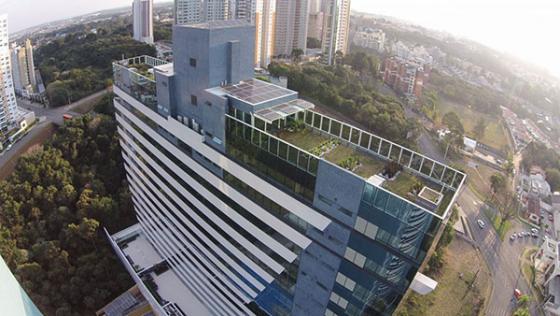

The USGBC has on August 14th, 2019, certified the first LEED Zero Water to the Eurobusiness, a commercial office building located in Curitiba, Brazil. The building had already achieved the Platinum certification in 2016, the highest LEED achievement at that period. As soon the LEED Zero certification was announced in 2018, the investors of Eurobusiness decided to take some actions to make it happen. Then, Petinelli ( the same green building consulting firm that earned the first LEED Zero Energy certification) was responsible for doing whatever it would take to it work.
“We were excited to have the first LEED Platinum office building in our region. At the time, LEED Zero Water didn’t exist. We did it because it was the right thing to do. But now, to have its actual, measured performance certified under LEED Zero is just thrilling,” says the building’s developer and investor Marcos Bodanese.
The commercial office building with 14 stories treats 100% of its wastewater, including grey and black water, through a constructed wetland on its roof. Petinelli reminds the importance of proving accurate data through metering to achieve an efficient result. In the Eurobusiness case, it uses 57% of toilet water, 15%of shower water, 16% of tap water, and 12% of irrigation water. To reduce the consume some strategies were taken. For the toilets, they changed it to dual flush, for showers, it is now a 6.0L/min shower, for the taps, there is an automatic system to turn it off after 12 seconds, and for the irrigation, it is xeriscaping.
The water treatment happens with grey and black water being reused in places of no human contact, like toilets and irrigation. For taps and showers, it still being used potable water from the artesian well as primary use and using the municipally treated potable water as a backup source.
The wetland is part of the treatment system consisting of the use of fine gravel and plants with macrophytes, aquatic plants that thrive in or near water to filter the wastewater. The treatment is natural with no chemicals, being the most economical solution. All wastewater from toilet flushing or infiltrated on-site is treated by a decomposition system in case of solids presence, following by oxygenation, then filtered by the plant on the wetland and oxidized by sand and coal. After this process, the water is biologically pigmented. Purple meaning reused non-potable water, and Green meaning reused potable water.
“Alternative water sources played a large role as well, contributing to an 82% reduction in potable water use. During a measured 12 months, 65% of all water used was reclaimed”, says USGBC.
With the efficient performance achieved, Petinelli affirms that the data will showcase the other projects coming, which will be an easy way to communicate to clients through real efficient results.
To read more: https://www.usgbc.org/articles/first-leed-zero-water-building-uses-multiple-strategies-get-zero
https://www.paladinoandco.com/blog/why-net-zero-water/
http://goinggreen.com.br/2018/03/21/net-zero-como-e-possivel-ser-autossuficiente-no-consumo-de-agua/
Replies: 0